Loading page…
Turning Bookeo Bookings into a Self-Maintaining Family CRM in GoHighLevel
Schedule a Meeting- Systems connected
- 2
- Programs routed
- 3
- Manual data entry
- No needed
- Custom code written
- 0 lines
- Build time
- 1 week
The Challenge
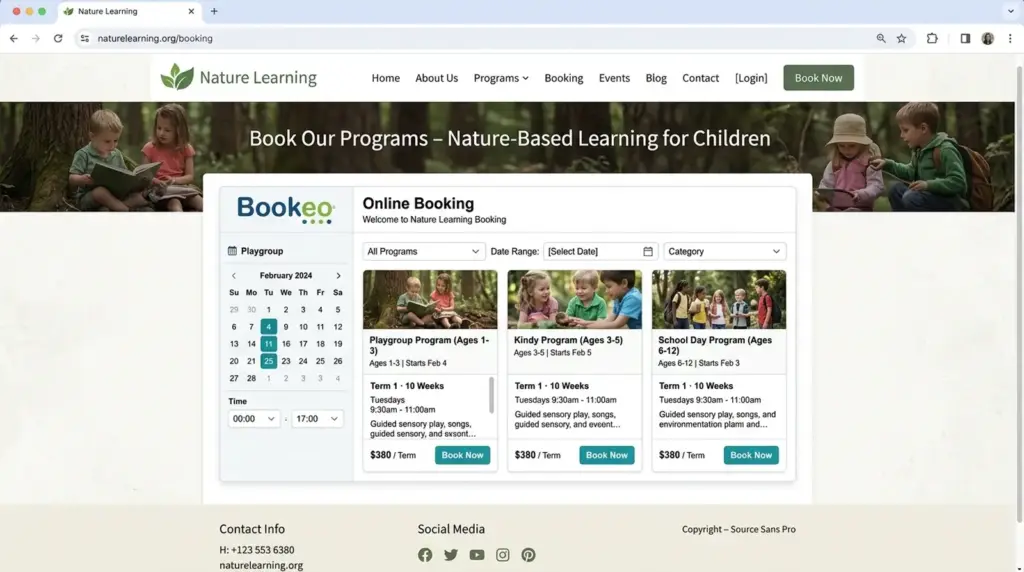
An outdoor education provider in Australia runs three children’s programs — a playgroup, a kindergarten session, and a school day — on set weekdays, sold by the term, four terms a year. Families book through Bookeo embedded directly on their WordPress website, where Bookeo reliably handles bookings, payments, and automated reminders.
The operational bottleneck was everything that happened after the booking. The business owner had no consolidated view of which families were actively enrolled right now, and no institutional memory of which programs a family had attended in earlier terms. Because families rebook term after term, that historical data was the single most valuable asset the business possessed — yet it remained trapped inside an unsearchable transactional booking list.
The client had three clear operational requirements:
- Message all current families within a specific program simultaneously.
- Launch a segmented email newsletter.
- Open any family’s CRM record and immediately review their complete multi-term participation history.
The digital agency managing the client’s marketing infrastructure had already selected GoHighLevel (GHL) as the CRM. The project brief was firm: keep Bookeo exactly as it is, sync every booking into GoHighLevel automatically, and do it without custom engineering — avoiding high-maintenance bespoke code for a straightforward data pipe.
What We Built
We engineered a reliable, zero-code pipeline across three distinct layers: Bookeo triggers on every confirmed booking, Zapier maps the data payload to a GoHighLevel contact, and an internal GoHighLevel workflow routes the contact into the appropriate program stage.
1. Inside GoHighLevel:
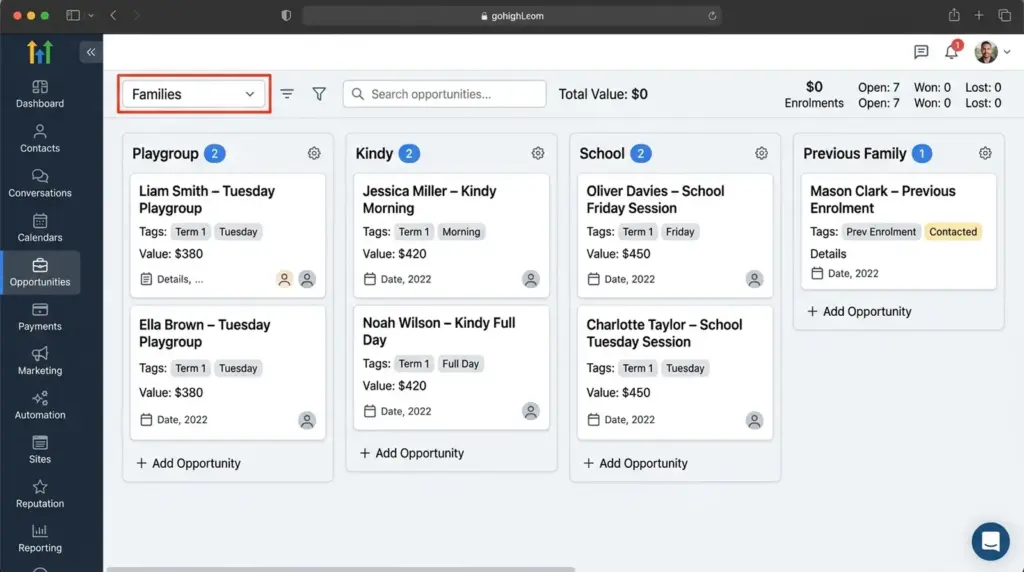
We established a dedicated Families pipeline containing stages for each core program — Playgroup, Kindy, and School — alongside New Enquiry and Previous Family stages. We configured two key custom fields on the contact record:
- Session: Captures the exact Bookeo product name verbatim.
- Booking Number: Captures Bookeo’s unique transaction ID (the primary key for downstream cancellations and modifications).
2. Inside Zapier:
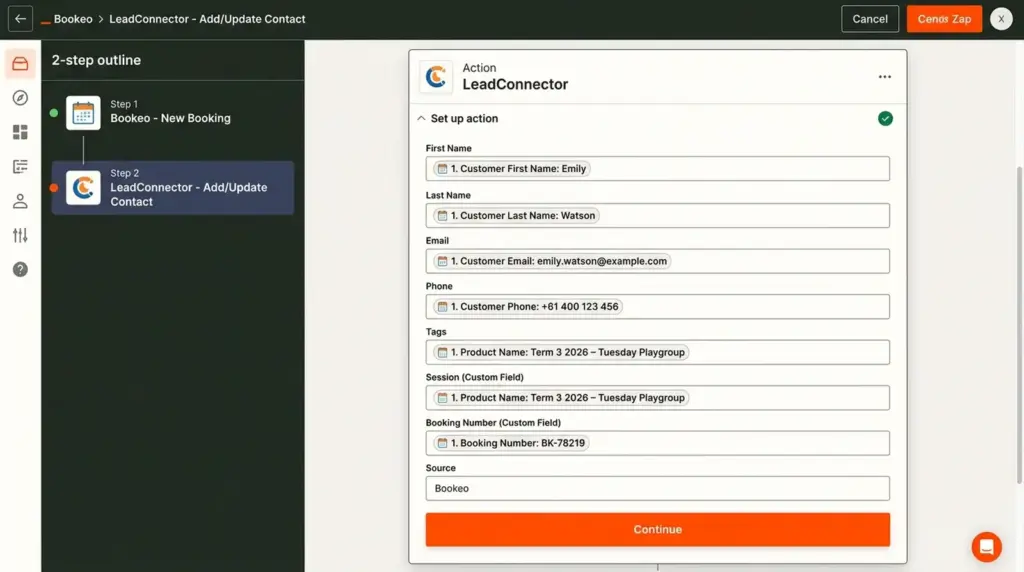
A streamlined two-step Zap listens for Bookeo’s New Booking trigger and calls LeadConnector’s Add/Update Contact action. It pushes the parent’s full name, email, phone number, physical address, both custom fields, sets the Lead Source to Bookeo, and applies the crucial architectural component: writing the Bookeo product name directly into the contact’s tags.
3. Inside GoHighLevel Automation Workflows:
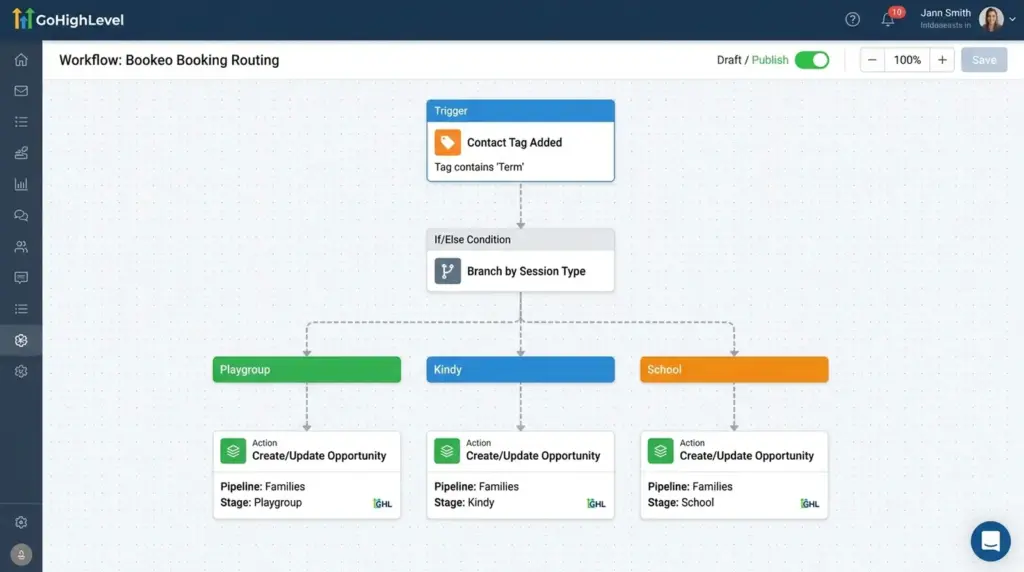
A native GHL workflow triggers instantly whenever an incoming booking tag is applied. An internal conditional branch inspects the Session field and divides execution across three routes. Each branch creates or updates an opportunity card within the matching stage, titled with the family surname and session name. Because the logic updates rather than duplicates, re-enrolling families simply move across the board. Backward movements were deliberately enabled so families transitioning from Previous Family seamlessly reactivate into an active term stage.
The Design Decision That Mattered
The client’s highest-priority requirement was also the easiest to over-engineer: they needed the CRM pipeline to show who is enrolled right now, while simultaneously maintaining an immutable history of every program a family has ever attended across multiple years.
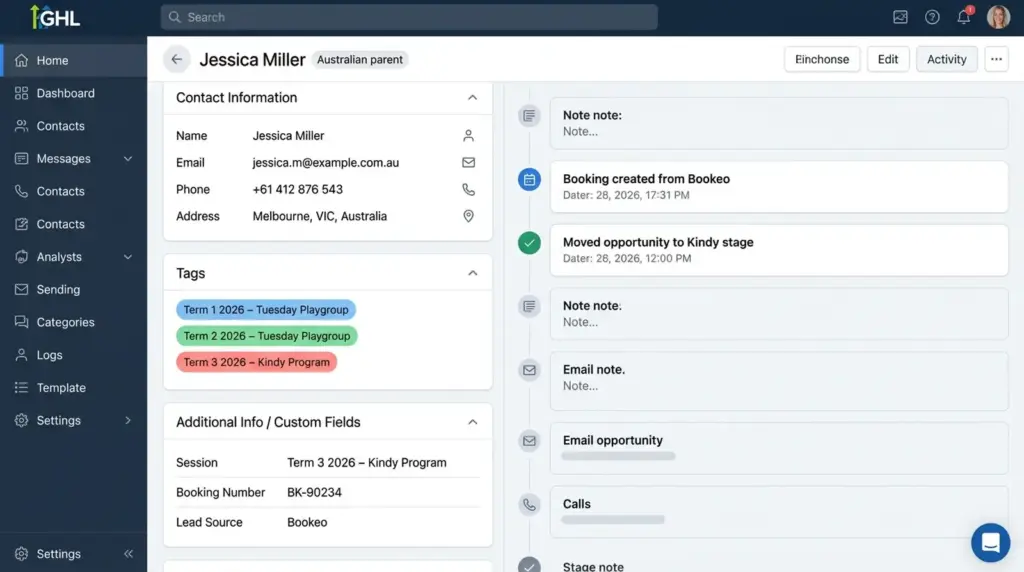
Rather than writing complex custom database lookup tables or synchronization scripts, we resolved this with a robust naming architecture: the tag applied to each contact mirrors the Bookeo product name verbatim.
Because every term’s sessions are named uniquely (e.g., Term 3 2026 – Tuesday Playgroup, Term 4 2026 – Kindy), each subsequent booking adds an incremental tag. Tags are never purged. Over time, each family’s contact profile accumulates a self-documenting chronological attendance record: no lookup tables, no recurring calendar scripts, and zero administrative overhead at the turn of the new year.
The pipeline answers “who is here this term.” The tags answer “who has ever been here.”
Two operational questions, two simple data structures, powered by a single automation.
Decisions Behind the Build
- No custom code, by design: While a bespoke Bookeo API integration was feasible, Zapier offers official native connectors for both Bookeo and GoHighLevel. For a small education business, relying on supported standard connectors provides far greater long-term reliability than tying uptime to custom codebase maintenance.
- Routing managed inside GoHighLevel: Zapier could technically assign pipeline stages directly, but pipeline stages are hard-coded in Zapier steps. Shifting branching logic into GoHighLevel allows the client’s digital agency to update rules and sessions directly in GHL without needing Zapier access.
- Full client data ownership: The automation runs in the agency’s primary Zapier workspace. No third-party middleware or external agency dependencies were introduced.
Results & Impact
- Zero manual entry: 100% of Bookeo bookings sync into GoHighLevel in real time without duplicates or missing details.
- Single-pane visibility: Management can view active enrollments by program at a glance on the pipeline board.
- Permanent customer history: Every family profile contains a complete historical record of past sessions and terms attended.
- Targeted communication: Program-wide broadcasts and parent messaging require just a simple filter, laying the groundwork for WhatsApp and email newsletters.
- Fast, reliable delivery: Completed and tested in under 1 week with 0 lines of custom code to maintain.
Have Questions?
Have Questions?



- No, there is currently no direct Bookeo integration within the GoHighLevel App Marketplace. The most stable and cost-effective approach is utilizing Zapier (which offers native connectors for both applications) or a custom webhook implementation for enterprise volume.
- Yes. Any integration requiring more than a single trigger and action step requires a paid tier. Additionally, paid Zapier plans offer faster polling intervals (under 2 minutes) compared to free tier limits.
- No. GoHighLevel's LeadConnector Add/Update Contact action matches incoming data against existing email addresses. If a family already exists, it updates their profile and appends the new term tag without duplicating records.
- Yes. The exact same architecture applies to Calendly, Acuity, Timely, or any booking system supporting Zapier triggers or standard webhooks. The key is implementing the standardized tag-naming rule.
Let's Achieve Success by Working Together
Schedule A Call To Discuss Your Idea. After Understanding Your Goals And Requirements, We'll Send You A Proposal. Once Approved, We'll Get Started To Achieve The Success.

Jakirul Islam
CEO & Founder
Not Interested To Submit The Form?
Book A Call Directly