


- WordPress
The Importance of WordPress Security: Developer Guide, Hardening & Checklist
Saiful Islam5 min read
Loading page…
Loading page…
Loading page…
Discover why modern businesses and organizations continue to choose WordPress in 2026, and how open-source architecture drives SEO success in the age of AI.
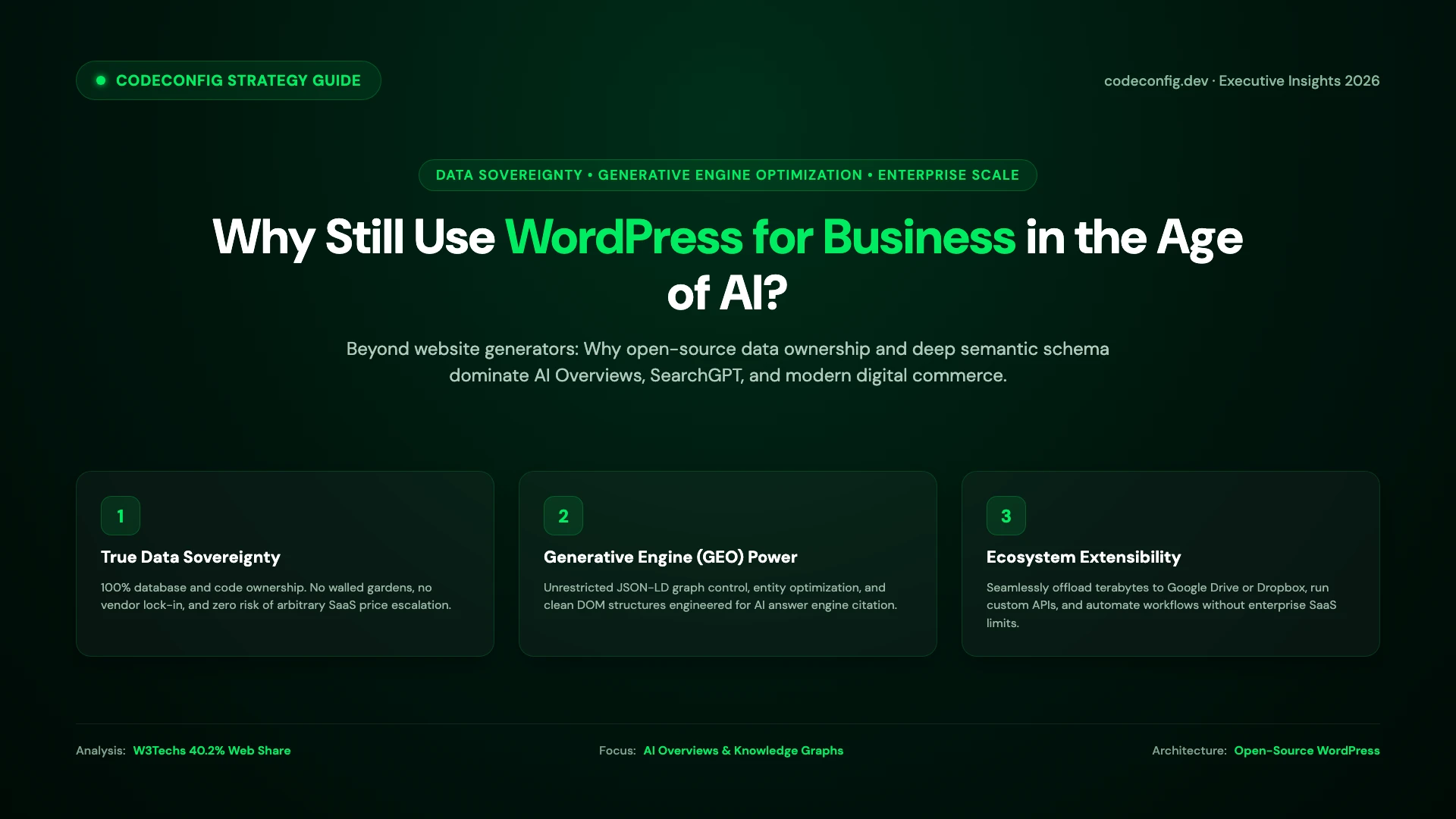
Understanding why use WordPress for business and organization growth has never been more relevant than in 2026. With artificial intelligence capable of drafting web pages in seconds, business leaders face an important decision: rely on closed proprietary site builders, or invest in an open-source content operating system that protects their long-term digital independence.
While AI prototyping tools can produce a functional visual frontend, running an active commercial enterprise requires much more than static code. It demands structured databases, granular permission levels, reliable revision histories, and seamless third-party service connections.
At the same time, the transition toward AI search engines—including Google AI Overviews, SearchGPT, and Perplexity—has completely altered how web content is discovered and evaluated. In this guide, we examine why organizations worldwide continue to build on WordPress, and how open-source architecture gives your business a distinct technical advantage in the age of generative search.
Businesses still choose WordPress because it provides a complete operational system for managing content, commerce, and user permissions, rather than just generating a single static design snapshot.
Modern AI website generators can produce impressive one-off landing pages. However, the true operational cost of a business website is not the launch date—it is the hundreds of iterative updates, product edits, employee permission adjustments, and campaign launches that follow over the next three to five years.
When an internal team needs to adjust product pricing, update operational hours, or publish quarterly financial reports, they cannot safely re-prompt a generative code model without risking layout regressions. WordPress separates site styling from structured database content. Non-technical staff can draft, edit, and publish updates in an intuitive visual editor, while developers retain complete programmatic control under the hood.
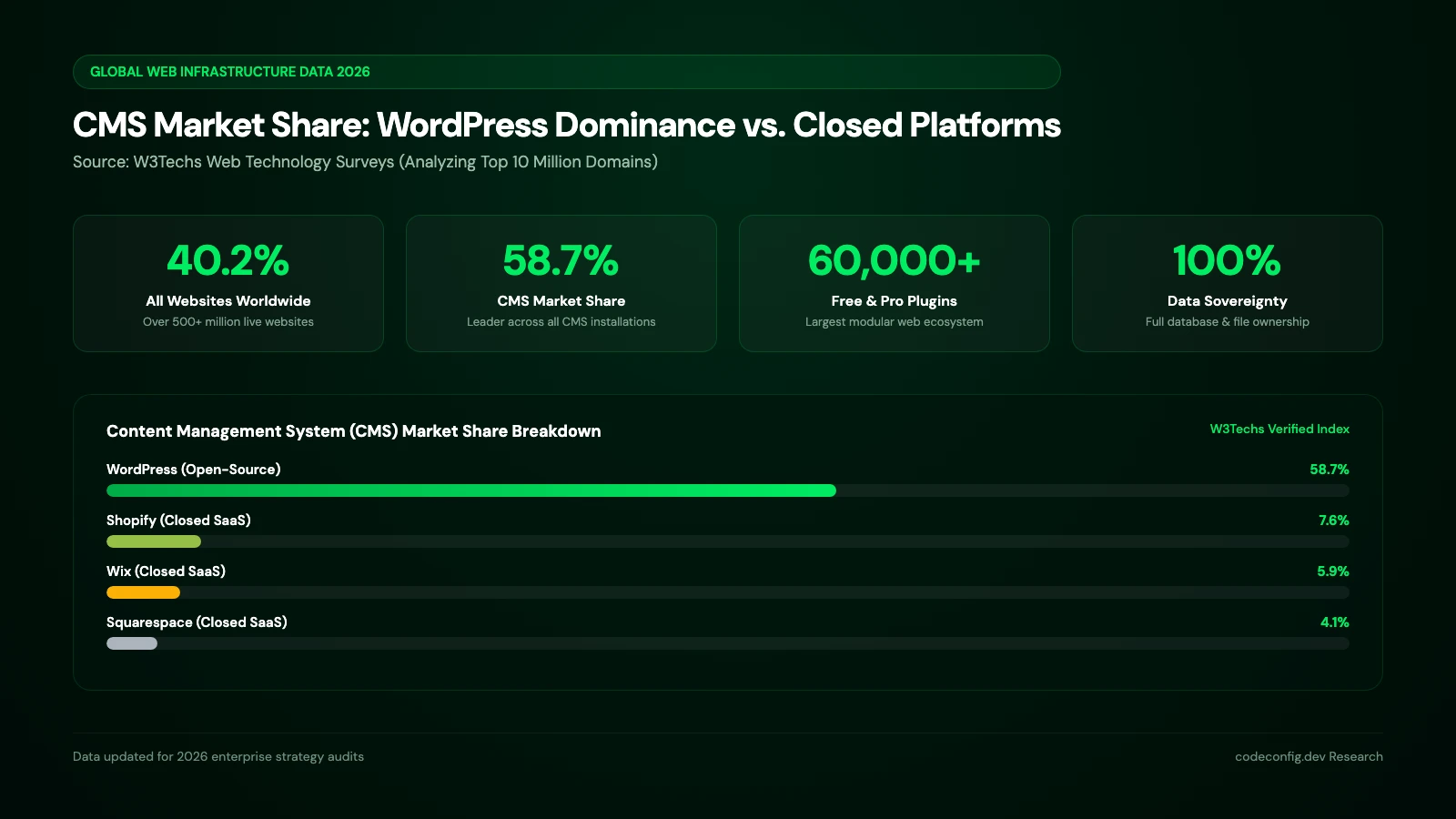
WordPress maintains an unmatched position as the backbone of global digital commerce, commanding over 40% of all websites and nearly 59% of all CMS-driven platforms.
According to continuous tracking data from W3Techs web technology surveys, WordPress remains the most widely deployed content management system on the internet. Its nearest competitors—Shopify and Wix—represent single-digit market shares of roughly 5.4% and 4.2% respectively.
This market dominance provides concrete business advantages that proprietary platforms cannot match:
Opting for WordPress grants your business full data sovereignty, ensuring your databases, customer records, and media libraries belong exclusively to you, free from platform lock-in.
When you build on closed Software-as-a-Service platforms such as Wix, Squarespace, or Shopify, you rent space inside a walled garden. You do not own the underlying code or the database schema. If that provider alters their terms of service, doubles subscription pricing, or experiences an enterprise outage, your business has no immediate technical recourse.

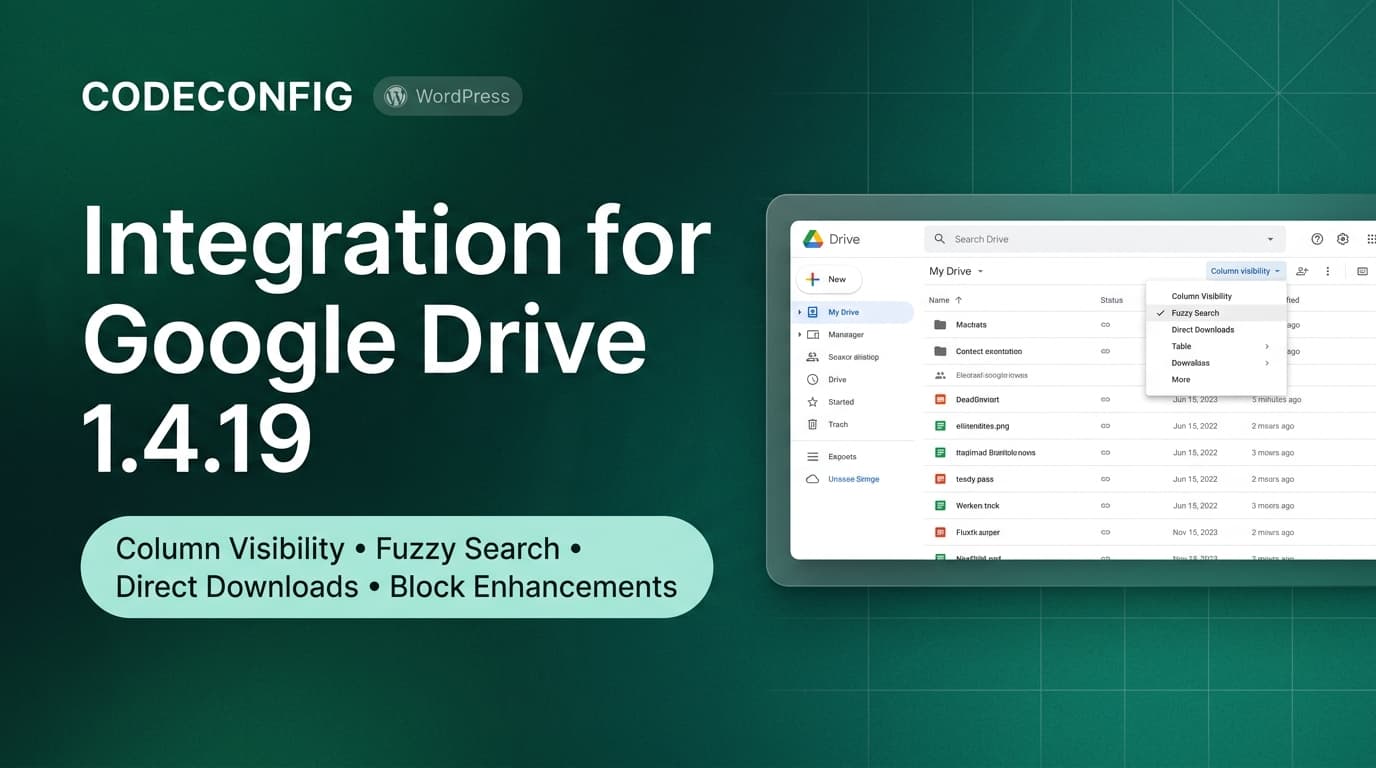
With self-hosted WordPress, your business retains total ownership of every database row, media file, and code repository. You can migrate your entire site across hosting providers in under an hour. When scaling high-volume digital assets, you can offload media libraries and automated archives directly to your own cloud infrastructure using Integration for Google Drive or Integrate Dropbox, avoiding expensive proprietary storage surcharges.
WordPress provides the granular technical control required for Generative Engine Optimization (GEO), enabling search engines and AI models to index, comprehend, and cite your content accurately.
Organic search has evolved beyond traditional ten-blue-link results. Large Language Models and AI answer engines—such as Google AI Overviews, SearchGPT, and Perplexity—rely on Retrieval-Augmented Generation (RAG) to synthesize answers directly on the search results page. To appear as a primary citation inside an AI answer, your content must be structurally machine-readable.

WordPress excels in generative search environments for several core reasons:
robots.txt and llms.txt files. You can grant access to search discovery bots like OAI-SearchBot and PerplexityBot while restricting unauthorized scraping bots from consuming server resources.WooCommerce gives organizations complete control over their transaction fees, payment gateways, and customer purchase data, eliminating arbitrary SaaS revenue penalties.
For businesses engaged in online commerce, platform economics are critical. Proprietary e-commerce platforms often impose escalating percentage fees on transactions processed outside their preferred payment gateways, on top of monthly subscription tiers and app add-on costs.
Because WooCommerce is built on open-source WordPress, your enterprise pays zero platform commission fees on sales. You integrate directly with payment processors such as Stripe, PayPal, or local merchant gateways under your existing negotiated commercial terms.
Furthermore, WooCommerce effortlessly accommodates complex business models that closed platforms struggle to support, including custom wholesale B2B pricing tiers, recurring memberships, multi-vendor marketplaces, and customized subscription workflows.
Modern WordPress installations deliver exceptional site speed and Core Web Vitals scores by pairing clean block themes with tailored server-side caching and content delivery networks.
A common misconception is that WordPress is inherently slow. In reality, site speed depends on hosting architecture and code discipline. Modern WordPress development utilizes lightweight block-based themes and native WebP image delivery, easily achieving near-perfect scores on Google’s Core Web Vitals metrics, including Largest Contentful Paint (LCP) and Interaction to Next Paint (INP).
According to technical guidelines published in the Google Search Central structured data documentation, search crawlers allocate finite rendering budgets per domain. Heavy JavaScript single-page applications often suffer indexing delays because bots must execute client-side scripts before reading page copy. WordPress serves pre-rendered HTML instantly from server caches, ensuring instant crawler comprehension.
For organizations streaming video or audio assets, hosting media locally can consume server bandwidth and compromise page responsiveness. Utilizing specialized tools like WP Media Player allows you to stream media smoothly while keeping your visitor data private and your page load times rapid.
Evaluating WordPress against proprietary site builders and standalone AI code generators clarifies why established businesses select open-source frameworks for mission-critical infrastructure.
The comparative table below outlines how each platform model performs across critical operational categories:
| Evaluation Factor | Open-Source WordPress | Closed SaaS (Wix / Squarespace) | Pure AI Code Generators |
|---|---|---|---|
| Data & Code Sovereignty | 100% full ownership of files and database | Rented inside proprietary walled garden | Full code ownership (unmanaged infrastructure) |
| Hosting Portability | Migrate to any cloud or host in minutes | Locked to vendor platform permanently | Requires custom DevOps and deployment pipeline |
| Generative AI SEO & Schema | Granular JSON-LD, custom entities, llms.txt | Restricted to pre-configured schema presets | Requires manual custom developer implementation |
| Content Editing Experience | Intuitive visual block editor with revision history | Visual drag-and-drop builder | Requires manual code edits or prompt iteration |
| E-Commerce Complexity | WooCommerce: unlimited products, rules, and gateways | Fixed tiers, transaction fees, limited gateways | Requires complex custom backend programming |
| Long-Term Cost of Change | Predictable, modular plugin ecosystem | Steadily escalating annual subscription pricing | High recurring developer refactoring costs |
While closed website builders offer fast onboarding for simple personal projects, they introduce severe constraints as an organization expands. Enterprise teams facing complex multi-site architectures or database migrations often partner with dedicated specialists like the CodeConfig WordPress Migration service to transition proprietary sites smoothly into flexible WordPress environments.
Implementing disciplined technical practices ensures your WordPress website maintains elite security, high conversion rates, and consistent search engine visibility.
To maximize your return on investment, adopt these four core operational standards:
Deciding why use WordPress for business in 2026 comes down to control, ownership, and search discoverability. As artificial intelligence continues to reshape digital commerce and search behavior, organizations that own their data and control their semantic infrastructure will retain a decisive competitive advantage.
By pairing WordPress with modern cloud storage, clean schema graphs, and disciplined performance practices, your business builds on an adaptable foundation designed to thrive through every technological evolution.
This post is by Tanin Ahmed, a member of the CodeConfig team who is always working to find solutions for our users and improve our services.
Thank you for reading and for your kind words and good wishes for us. We truly appreciate your support! ❤️
Whether you're just getting started or scaling fast, we've got you covered. Access helpful guidance.

