

- Elementor
- WordPress
How to Offload Media in Elementor: 5 Best Ways to Boost Speed
Saiful Islam7 min read
Loading page…
Loading page…
Loading page…
Why an owned website is essential in the age of AI: protect your personal brand against social media bans, build unshakeable trust, and own your customer audience.
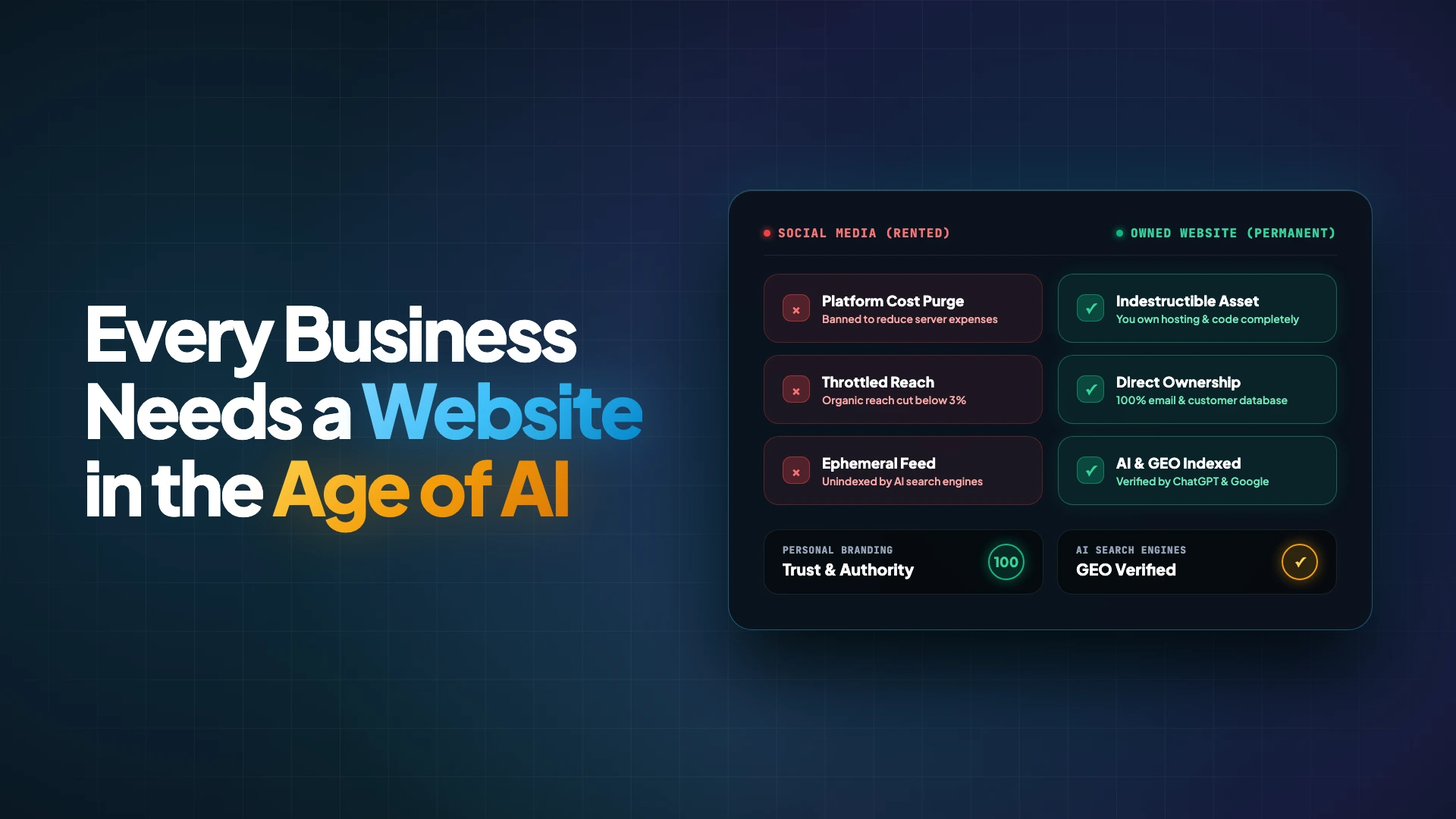
Understanding why every business needs a website in the age of artificial intelligence is an urgent commercial priority. If your entire business relies on social media profiles, you are building on rented land. While social networks can shadowban, suspend, or throttle your profile without warning, an owned website is an indestructible digital asset that you control entirely.
In this guide, you will learn why an independent website is essential for personal branding and trust, how generative AI search engines evaluate your company, and the most popular methods to launch a high-performing business website today.

Social media platforms like LinkedIn, X, Instagram, Facebook, and TikTok are powerful distribution channels, but they are not your property. When you rely solely on a profile page to run your business, you surrender control over your audience, your branding, and your revenue.
Every business owner who operates exclusively on social media faces four existential risks:
Social networks view unpaid users as server overhead. On your own website, you fund your own infrastructure. Nobody can delete your business or silence your audience to protect their corporate profit margins.
By contrast, your website cannot be deactivated by a third-party algorithm. When you own your domain name, web hosting, and database, you retain full sovereignty over your brand. If you ever run into technical hiccups or server configuration snags, you can always diagnose and fix common WordPress website problems without begging an automated social media support bot to restore your business.
Generative AI tools have made content creation frictionless. With a single prompt, anyone can produce hundreds of synthetic social media posts, generate lifelike avatar videos, and mimic thought leadership. Because low-effort content has saturated social feeds, prospective clients and business partners have developed acute skepticism toward social media personas.
This trust dynamic is a primary reason why every business needs a website today. In high-stakes B2B deals, consulting engagements, and enterprise transactions, decision-makers conduct rigorous background research before signing contracts or wiring funds. They look for tangible indicators of permanence and legitimacy:
yourname.com or company.com) signals that you have made a financial and legal investment in your business infrastructure.ceo@yourcompany.com) inspires far greater confidence than communicating through generic free webmail accounts.The search landscape has shifted fundamentally from traditional ten blue links to Generative Engine Optimization (GEO). Tools like Google AI Overviews, Perplexity AI, and ChatGPT Search act as autonomous research assistants for consumers and business buyers.
When an executive asks an AI engine to recommend top service providers, the AI does not scrape ephemeral social media stories. Instead, it crawls structured web documents, authoritative domain entities, and schema markup (JSON-LD). If your business does not maintain an indexed, crawlable website, AI discovery engines literally treat your company as nonexistent.
Equally important, an open-source website enables you to maintain structured knowledge graphs that modern AI crawlers prioritize. As detailed in our breakdown of why businesses choose WordPress for SEO in the age of AI, open architecture allows search crawlers to verify your business credentials, service offerings, and authority faster than any closed platform.
Choosing the right technology stack depends on your budget, technical resources, and long-term ownership goals. Here is an objective analysis of the most popular methods used by modern business owners:
Self-hosted WordPress powers over 43% of the web according to data from W3Techs web technology surveys. It remains the gold standard for entrepreneurs who demand complete digital sovereignty. You own the code, the database, and the media library, with zero ongoing platform subscription taxes.
Visual website builders like Webflow and Framer allow designers to build visually striking landing pages with smooth animations without writing raw code. They handle cloud hosting and SSL configuration out of the box.
For businesses whose primary model is selling physical or digital merchandise, dedicated commerce solutions streamline inventory and payment processing. Shopify provides an all-in-one managed SaaS environment, while WooCommerce (built on WordPress) gives you complete control over your customer data and eliminates proprietary transaction fees.
For custom web applications and lightning-fast enterprise sites, modern JavaScript frameworks like Next.js or Astro paired with a headless backend offer top-tier performance. Pages are pre-rendered into static HTML or served through edge CDNs for instant load times.
Modern AI coding tools like v0, Claude Artifacts, and Bolt have transformed how initial site layouts are conceptualized. Business owners can prompt an AI model with their brand guidelines and receive production-grade HTML and Tailwind CSS layouts in minutes. These assets can then be converted into modular block themes or integrated into dynamic content frameworks.
| Platform Method | Data Ownership | Ease of Setup | Scalability | Monthly Platform Cost |
|---|---|---|---|---|
| Self-Hosted WordPress | 100% Complete | Moderate | Infinite | Low (Hosting only: $5-$30/mo) |
| Webflow / Framer | Partial (Hosted SaaS) | High | Moderate | Medium ($20-$60/mo) |
| Shopify | Partial (Proprietary) | High | High (Commerce) | Medium-High ($39-$399/mo + fees) |
| Headless / Next.js | 100% Complete | Low (Code-heavy) | Enterprise | Variable ($20-$200+/mo hosting) |
| AI Rapid Prototyping | 100% (Exported Code) | Instant | Modular | Low ($20/mo AI tool subscription) |
Transitioning from platform dependency to digital ownership does not require months of development. Follow these strategic milestones to establish a resilient web presence:
This post is by Jakir, a member of the CodeConfig team who is always working to find solutions for our users and improve our services.
Thank you for reading and for your kind words and good wishes for us. We truly appreciate your support! ❤️
Whether you're just getting started or scaling fast, we've got you covered. Access helpful guidance.

